
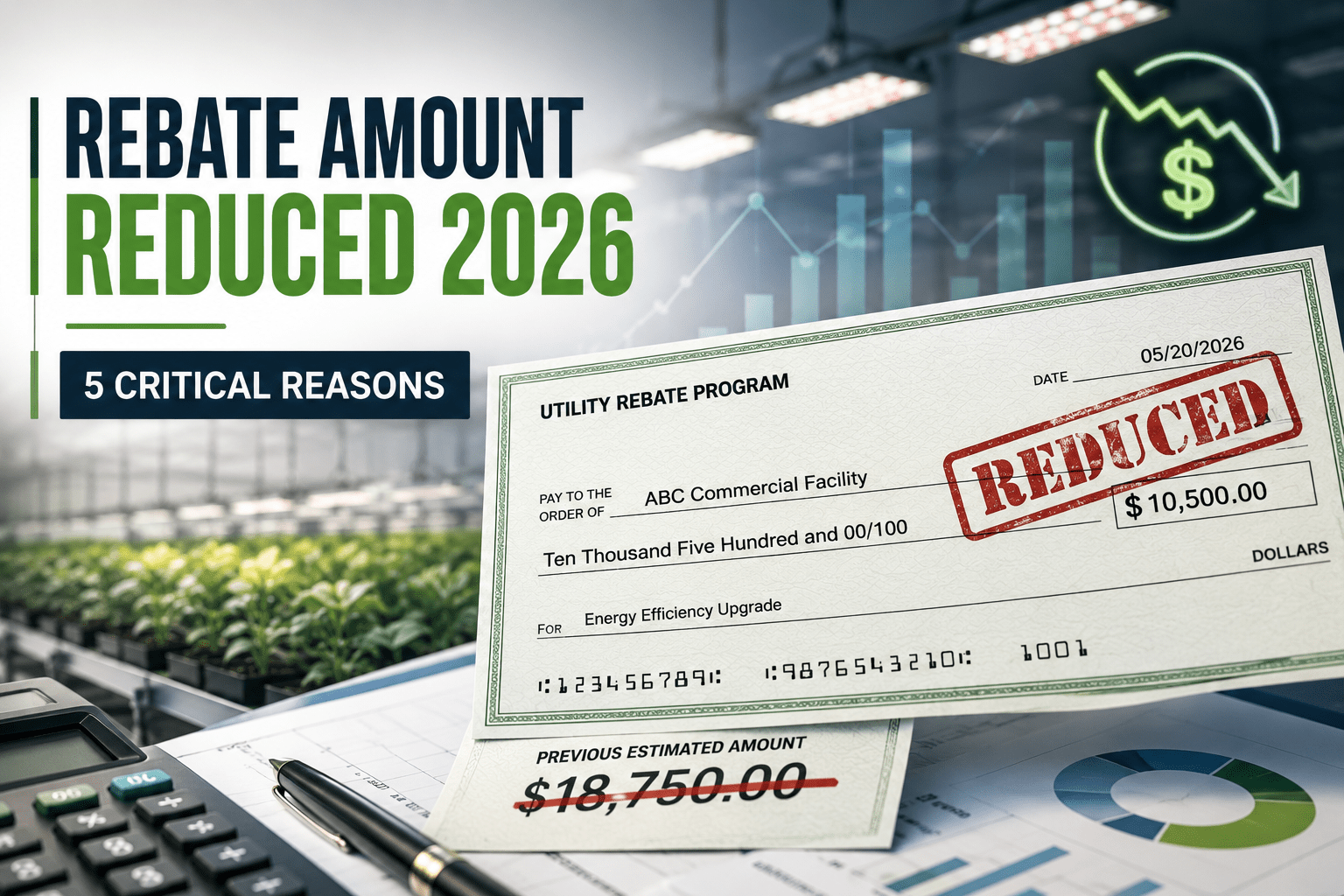
Rebate amount reduced 2026 is becoming a common concern for commercial facilities that expected one incentive value but received a lower approved amount after review. In many cases, the rebate was not rejected. The project may still qualify, the application may still move forward, and the equipment may still be eligible. However, the final rebate amount can change when utilities review assumptions, funding conditions, documentation confidence, and verification results.
This is why many applicants ask why my rebate amount reduced after approval or after receiving updated program feedback. The issue is rarely explained in a way that shows the full picture. A reduced rebate amount may come from several review layers working together, not one obvious mistake.
For facilities planning around a specific rebate value, this creates risk. A lower approved amount can affect equipment budgets, project timing, cash flow, and internal approvals. If your project depends on a predictable rebate outcome, contact us for grow light rebate details before accepting a reduced amount without review.
Rebate Amount Reduced 2026: Why Estimates Change
Estimated rebate value is not final approval
A rebate estimate is only an early projection. It may be based on available program information, expected equipment performance, baseline assumptions, and preliminary project details. Final approval depends on how the utility or program reviewer evaluates the full project.
This difference matters because many facilities treat early rebate numbers as fixed. They make purchasing decisions, schedule installations, or build internal budgets around an estimate. If the final approved amount changes, the project may still be approved, but the financial expectation changes with it.
Utilities may adjust assumptions during review
Program reviewers do not always accept submitted assumptions exactly as presented. They may interpret operating schedules, equipment data, baseline conditions, or savings expectations differently. When those assumptions change, the approved rebate amount can change as well.
This does not always mean the project was handled incorrectly. It means the final calculation followed the reviewer’s interpretation of the project, not the applicant’s expectation.
Reduced amount does not always mean failure
A reduced rebate amount is not the same as rejection. In many cases, the project remains valid but receives a lower incentive because the reviewer sees less confidence in the original value. The danger is that facilities may not know whether the reduction is reasonable, avoidable, or worth reviewing further.
That uncertainty is exactly why project-specific review matters. General rebate information cannot explain why one specific project received a lower amount.
The 5 Critical Reasons Rebate Amounts Get Reduced
1. Baseline assumptions changed
Baseline assumptions can strongly affect rebate value. If the program compares the existing condition against the proposed upgrade, any adjustment to the baseline can reduce the calculated savings. Lower calculated savings usually means a lower approved rebate amount.
Facilities often do not see this issue clearly because baseline assumptions may feel like a technical detail. However, when the reviewer changes how the original system is interpreted, the approved value can move significantly.
2. Performance data created uncertainty
Performance data plays a major role in rebate review. If the submitted data does not clearly support the requested incentive value, the reviewer may apply a more conservative interpretation. That can reduce the final amount without rejecting the project entirely.
Projects using commercial lighting platforms built for large-scale applications may reduce confusion when equipment information is consistent and easier to interpret. Still, every project must be reviewed inside its own utility and program context.
3. Timing changed the funding condition
Rebate amount reductions can also happen when timing changes. Utility programs operate within budget cycles, review queues, and funding availability. A project that looked stronger earlier in the cycle may face tighter conditions later.
This is one reason facilities should not treat rebate timing as a small administrative issue. If the project enters review late, waits too long, or gets delayed during clarification, the funding environment can shift before final approval.
4. Verification did not match expectations
Verification can change the approved rebate amount. The program may need to confirm that the installed project matches what was submitted and that the expected savings still make sense. If the final project differs from the original review assumptions, the approved value may be adjusted.
Facilities using organized rolling bench layouts may create a more consistent physical environment for review, but layout consistency still needs to be understood inside the full project scope.
5. System complexity affected review confidence
Projects with multiple areas, layered lighting strategies, or different system types can create more interpretation during review. When reviewers need to separate measures, compare assumptions, or evaluate how systems interact, the final incentive value may become more conservative.
For example, projects involving structured under canopy lighting configurations may need clearer interpretation during review because those systems are often evaluated differently from standard top-lighting upgrades.
The important point is simple: a reduced rebate amount is often a review-confidence issue. The project may still qualify, but the reviewer may not support the original value at the level expected by the applicant.
Why Facilities Should Review a Reduced Rebate Amount
The reduction notice may not explain the full issue
A utility or program notice may show the updated rebate amount, but it may not clearly explain why the number changed. Even when a reason is provided, it may only describe the surface issue. The deeper question is whether the reduction came from documentation, performance interpretation, timing, budget conditions, or final verification.
Without understanding the real cause, it is difficult to know whether the reduced amount should be accepted, reviewed, or questioned further.
Guessing can make the situation worse
When a rebate amount is reduced, some applicants respond by sending more information without knowing what the reviewer actually needs. This can create additional confusion or delay. More documents do not always create more confidence. Sometimes they create more review work.
The better approach is not to guess. The better approach is to understand where the reduction likely formed and whether there is still a practical path to protect the project outcome.
Project-specific review is more valuable than generic advice
Generic rebate advice cannot explain why a specific project received a lower amount. A reduction may come from the utility program, the equipment category, the timing, the documentation structure, or the way the installed project was verified.
That is why facilities should avoid treating every reduced rebate amount the same way. The correct response depends on the actual project conditions.
Reduced incentives can affect more than the rebate
A lower rebate amount can affect equipment purchasing, installation scheduling, internal approvals, and return expectations. For commercial facilities, the rebate is often part of the financial plan. When the approved value changes, the project may need to be reassessed quickly.
Most facilities do not need more general rebate information at this stage. They need someone to look at the specific project, identify likely reduction pressure, and determine whether the outcome still has room to improve.
If your rebate amount was reduced, delayed, or changed after review, do not rely on assumptions. Contact us for grow light rebate details and get a static and swift result for your project.