
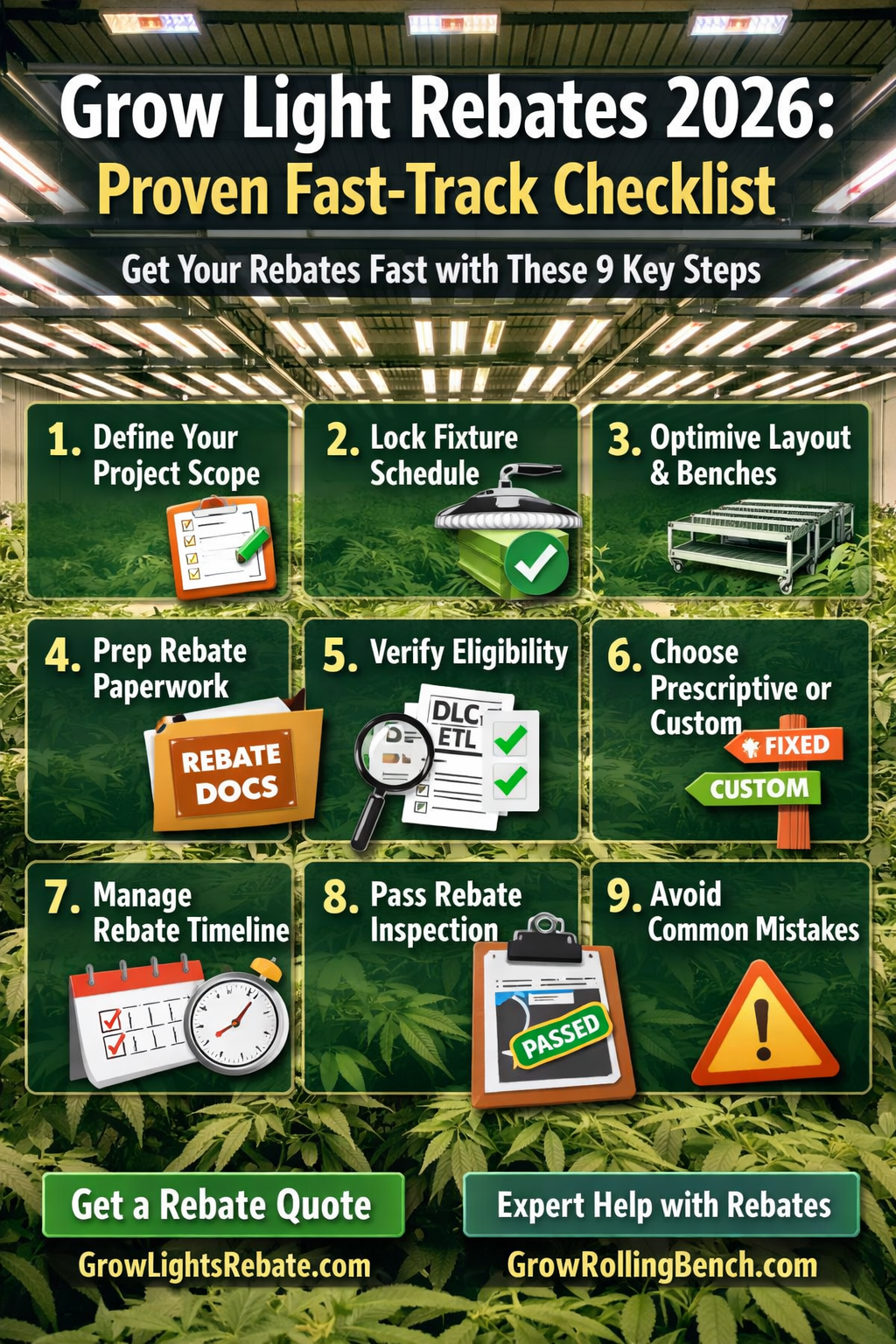
Energy costs can make or break margins in commercial cultivation—especially in indoor, greenhouse, and multi-tier environments where lighting, HVAC, and dehumidification run hard year-round. The good news is that grow light rebates (and related utility incentives) can dramatically reduce upgrade costs if you plan your project the right way from day one.
This 2026 checklist is written for operators and project managers who want fewer surprises: what utilities usually ask for, where approvals stall, and how to package a project so it moves through review with minimal rework. If you want a quick estimate with minimal back-and-forth, start here: request a rebate quote.
What “Grow Light Rebates” Usually Means in 2026
Most commercial programs treat horticulture lighting as a form of energy-efficiency retrofit or new construction measure. The incentive amount typically depends on some combination of (a) verified equipment eligibility, (b) measured or modeled energy savings, and (c) program rules such as caps, cost-share limits, and required documentation. Some programs are “prescriptive” (fixed rebates per fixture or per watt reduced), while others are “custom” (rebates tied to calculated kWh savings).
The practical takeaway: your project needs to tell a clean story—what you have today, what you are installing, where it will be installed, and how savings can be verified.
If you want a high-level refresher on how utility incentives work for grow facilities, Check lighting utility rebates here.
1) Build a Rebate-Ready Project Scope
Most delays are self-inflicted: missing scope details, mixing equipment categories in one unclear line item, or changing models midstream. Start with a one-page scope summary you can share with your team, vendors, and the program contact.
- Facility basics: enter your zip code, your service address, your utility provider, your area, and the name on the utility account.
- Spaces impacted: flower rooms, veg, mother, propagation, drying, greenhouse bays, or multi-tier racks.
- Upgrade categories: top lighting, under-canopy lighting, controls, HVAC, dehumidification.
- Project type: retrofit (replacing existing equipment) vs new build / expansion.
- Timing: target install date and whether you can wait for pre-approval.
Use your site’s News hub to keep state and program updates in one place, and link the exact post you used in your project notes so everyone references the same rule set.
2) Lock the Fixture Schedule Before You Buy Anything
A “fixture schedule” is the #1 document you should treat as sacred. Utilities and implementers use it to confirm eligibility, calculate savings, and plan any inspection. Your schedule should be simple enough that a reviewer can validate it in minutes.
Top-light schedule essentials
- Manufacturer + model number
- Input wattage (and dimming range if applicable)
- Quantity (by room/zone)
- Mounting height / canopy distance (approximate is fine)
- Control method (on/off, 0–10V, network control)
Example reference while you draft a schedule: 4-channel LED grow light (WeGrowPros).
Under-canopy schedule essentials
Under-canopy can be a separate measure with a separate savings story. Keep it separate on paper even if it’s part of the same physical project.
- Model + length (e.g., 4 ft vs 8 ft)
- Wattage and spectrum type
- Quantity by row/tier
- Mounting approach (tray/bench posts, rack rails, etc.)
Example category reference: Under Canopy Lights (single channel).
Pro tip: If fixtures are adjustable-wattage, document the intended operating setting for rebate purposes. In many programs, “nameplate” vs “operating” wattage differences create confusion if you don’t write it down clearly.
3) Layout and Benches Matter More Than You Think
Rebates are tied to energy savings, but real savings often depend on how efficiently you run rooms after an upgrade. Better canopy density and improved access can reduce wasted light and shorten task time—meaning you can keep conditions more consistent and reduce corrective HVAC runtime.
If you are upgrading infrastructure alongside lighting, stainless rolling benches can be part of a facility-wide efficiency plan. Example reference: V-Track rolling bench system.
Even if benches themselves are not rebated under a given program, including layout notes (tiers, benches, aisle plan, row spacing) helps reviewers understand your install context and can prevent inspection disputes later.
4) Use This Fast-Track Documentation Checklist
Utilities typically want a clear story: who you are, what you’re changing, what it costs, and how savings are verified. If you submit a tidy packet, you reduce follow-up emails and keep the timeline predictable.
| Item | What to Provide | Why It Matters |
|---|---|---|
| Utility bill | Most recent bill showing account + service address | Confirms territory and meter eligibility |
| Fixture schedule | Model, wattage, qty, room/zone assignment | Core input for savings + approval |
| Baseline inventory | Existing tech (HPS/LED), wattage, qty, hours of use | Required for retrofit savings math |
| Layout notes | Simple sketch or notes (tiers, benches, aisles) | Helps avoid scope disputes later |
| Quotes/invoices | Vendor quote and final invoice (if available) | Needed for cost-share and incentive calc |
| Install proof | Photos, serials, completion docs (if requested) | Supports inspection/verification |
Want us to review your packet and estimate the incentive path? Use: Get a rebate estimate.
5) Eligibility: Verify, Don’t Guess
Eligibility questions are where projects lose weeks. Don’t rely on “it should qualify.” Instead, document the proof trail you used so you can answer reviewer questions quickly.
- DLC Qualified Products Lists (QPL) for verifying listed products where applicable.
- ENERGY STAR rebate finder for broader equipment categories and incentive discovery.
For horticulture, the exact program language matters. Some utilities treat “indoor agriculture” as a dedicated segment; others fold it into commercial lighting. Keep a screenshot or PDF of any product listing and store it with your submission folder.
6) Prescriptive vs Custom: Which Path Should You Use?
If you want speed and simplicity, prescriptive measures often win: fewer modeling requirements and clearer incentive rules. If you want maximum payout, custom measures can outperform—especially when you are replacing high-wattage baselines and can document hours of operation.
- Prescriptive: fixed incentives by fixture or watt reduced; simpler paperwork; sometimes lower ceiling.
- Custom: incentive tied to calculated kWh savings; more documentation; can pay more for optimized designs.
If you’re not sure, use a hybrid approach: submit the most straightforward portion (top lights) prescriptively, then evaluate custom for the remaining categories (controls, integrated HVAC impacts) if the program allows.
7) Timeline: Keep the Process From Dragging Out
Rebate timelines vary, but most “slowdowns” come from predictable issues. Here is how to keep your project moving in 2026:
- Confirm pre-approval rules early. If pre-approval is required, buying first can disqualify you.
- Lock the bill of materials. Changing models or quantities triggers re-review.
- Send one clean packet. Piecemeal emails create back-and-forth and lost context.
- Plan for inspection. Keep serial numbers accessible and store install photos by room.
For a tighter speed-focused breakdown, see: Fast LED Grow Light Rebate Timeline.
8) Inspection: What Reviewers Typically Check
Inspections are often straightforward when your paperwork matches what is installed. Common checks include:
- Model numbers and quantity match the approved schedule
- Installed location aligns with the described rooms/zones
- Photos show fixtures powered and mounted (sometimes with context)
- Serial numbers or nameplates can be verified
- Controls (if included) are present and configured
Simple habit: take “before” and “after” photos from the same angle. It makes verification faster and reduces follow-up questions.
9) Common Mistakes That Cost You Money
- Mixing categories: bundling under-canopy and top lights as one line item without clarity.
- Missing baseline data: no record of existing wattage, quantity, or runtime.
- Buying too early: skipping pre-approval when required.
- Overstating savings: aggressive runtime assumptions that can’t be supported.
- Keyword stuffing: long, unnatural text blocks can weaken trust and readability.
10) Proof and Trust: Add a Simple Case Summary
Case pages help prospects see that the process is repeatable. Keep them practical: the problem, the scope, the paperwork path, and the outcome (even if you share results as ranges).
Example internal case page: Colorado grow rebate case.
FAQ: Grow Light Rebates 2026
Do I need pre-approval before I buy equipment?
Sometimes yes. Some programs require pre-approval or reserved budget before purchase/installation. If you’re not sure, treat pre-approval as the default safe path and ask early.
Can I combine top lights and under-canopy lights in one project?
Yes, but keep them as separate line items with separate fixture schedules to avoid scope confusion and delays.
What is the #1 mistake that slows rebates down?
Changing fixture models or quantities after paperwork is submitted. Lock the schedule first, then buy.
What should I do first if I want a quick rebate estimate?
Start with your utility provider, facility zip code, and a draft fixture schedule. Then submit details here: Quote Form.
Next Step: Get a Fast Rebate Estimate
If you want to move fast, send your utility provider + zip code + a rough fixture schedule. We’ll help map the cleanest path to approval and avoid the usual paperwork traps.