
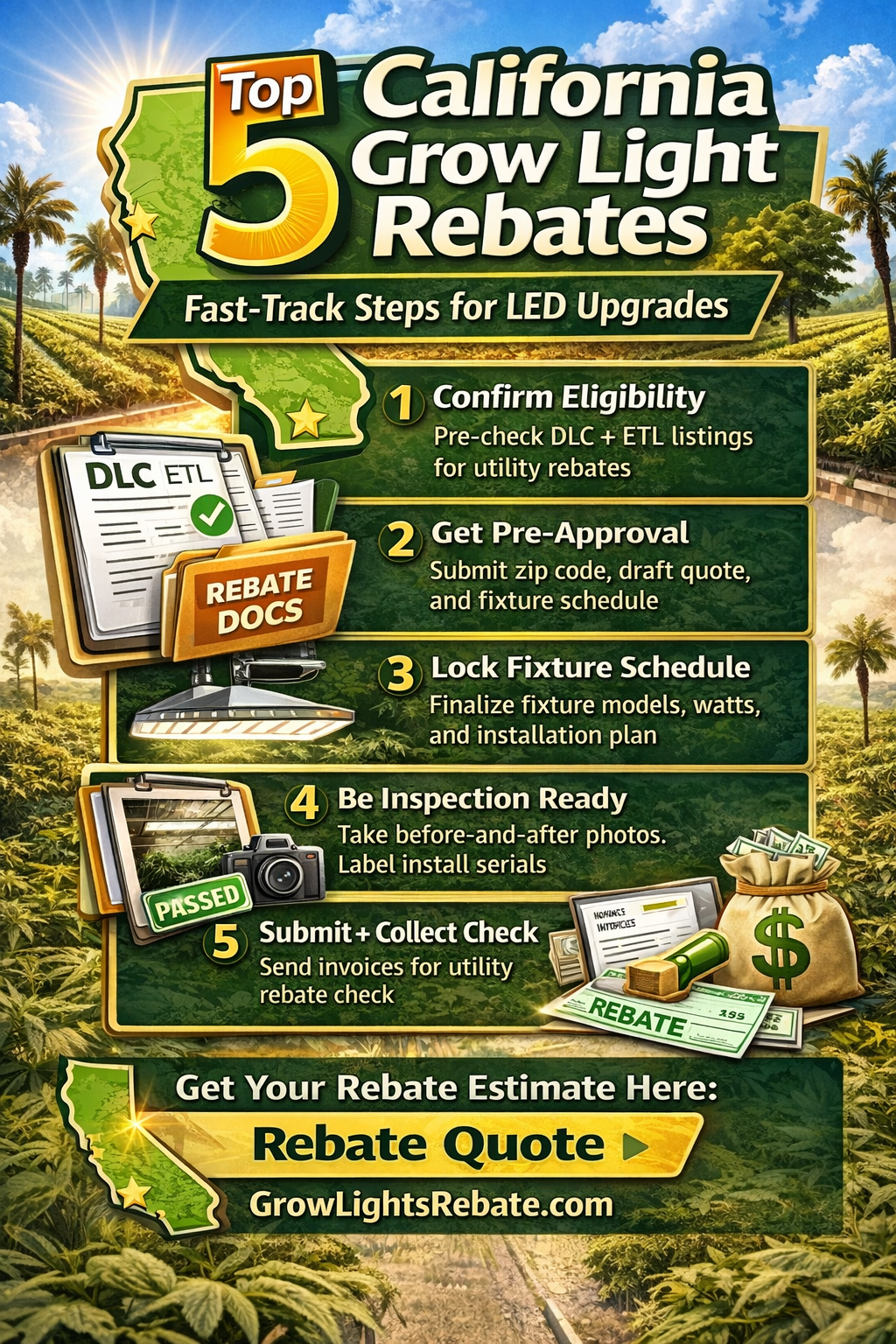
Focus keyword: grow light rebates
California growers deal with some of the highest commercial electricity costs in the U.S., which is why California Grow Light Rebates can be the fastest way to cut project payback time on LED upgrades. In 2026, the best outcomes usually go to facilities that prepare a clean rebate packet, lock the fixture schedule early, and align with common utility rules around eligibility, documentation, and inspection.
This guide explains how grow light rebates typically work across California service territories (SCE, PG&E, SDG&E), what to prepare before you buy, and how to avoid the mistakes that slow approvals. If you want a fast estimate, start here: Get a Grow Light Rebates Quote.
California Grow Light Rebates 2026: What Utilities Usually Want
Most California programs review horticulture lighting upgrades as an energy-efficiency measure. Your grow light rebates approval path typically depends on three things:
- Eligibility: your facility, utility account, and the equipment category qualify.
- Clarity: you provide a locked fixture schedule with model numbers, wattage, quantities, and locations.
- Proof: you can support baseline details and provide install/inspection evidence when requested.
Before you build a packet, skim your internal program update content so your team uses the same assumptions: SCE AgEE Program Updates and California Under-Canopy Rebates.
Service Territory Matters: SCE vs PG&E vs SDG&E
When growers say “California grow light rebates,” they often mean very different rules depending on which utility territory the meter is in. Your first step is always confirming the utility provider on the bill.
SCE (Southern California Edison): AgEE and indoor horticulture
SCE’s AgEE-focused updates are worth monitoring because incentive rates and requirements can change by date, category, and eligibility thresholds. Your submission is much easier when your fixture schedule matches the program’s performance expectations and you keep pre-approval timing clean.
PG&E (Pacific Gas and Electric): agriculture-focused programs
PG&E territory growers often see rebate pathways for indoor agriculture and greenhouse projects, especially when upgrades move from older tech toward high-efficacy LEDs and verified products. Always treat funding as “not guaranteed until approved” and avoid purchasing too early if pre-approval is required.
SDG&E (San Diego Gas & Electric): confirm program category early
SDG&E territory can involve different implementer workflows and documentation standards. The safest strategy for 2026 is: confirm the right program bucket, then submit a tidy rebate packet in one shot.
Shortcut: If you’re not sure which bucket you fit into, submit the basics through your quote intake first and we’ll tell you what matters most for your utility: Rebate Quote Form.
Fixture Strategy That Improves Approval Odds
For California grow light rebates, approvals move faster when you keep the equipment story simple: one schedule for top lights, one schedule for under-canopy, and a clear control plan. Don’t mix product models midstream.
Top lights: lock the “fixture schedule” early
Your top-light fixture schedule should be readable in under 60 seconds. Include:
- Manufacturer + model number
- Input wattage (and operating setting if adjustable)
- Quantity by room/zone
- Mounting height (approx.)
- Control method (on/off, 0–10V, network control)
If you need a reference point while you draft your schedule, you can link a representative LED category page from your ecosystem: LED Grow Lights (WeGrowPros).
Under-canopy: treat it as its own measure
California programs have specifically highlighted under-canopy incentives in recent cycles. Under-canopy lighting is easiest to rebate when you keep it as a separate line item (separate schedule, separate quantity, separate placement notes). Use a category reference like: Under-Canopy Lights (Single Channel).
Want a California-specific context piece to internally link from this page? Use your existing post: California Under-Canopy Rebates.
Controls and Documentation: The Hidden “Approval Accelerator”
Even when the fixtures qualify, many grow light rebates submissions stall because controls and documentation are vague. Don’t let “controls” be an afterthought—describe it as clearly as the fixtures.
- Basic controls: on/off schedules, room-level circuits
- Analog dimming: 0–10V where applicable
- Network controls: centralized scheduling, profiles by room, and audit-friendly configuration
When controls are part of the project story, it’s easier to justify intended operating wattage, runtime assumptions, and inspection verification for grow light rebates.
Fast-Track Rebate Packet Checklist (Copy/Paste)
Use this checklist to build a single “rebate packet” folder. This is the easiest way to reduce delays and avoid repeated requests for the same information.
| Document | What to Include | Why It Helps |
|---|---|---|
| Utility bill | Most recent bill with account name + service address | Confirms territory for grow light rebates |
| Fixture schedule | Model, wattage, qty, room/zone | Core approval + savings input |
| Baseline inventory | Existing fixtures: type, wattage, qty, runtime | Supports retrofit logic |
| Layout notes | Simple sketch: tiers, benches, aisles, rooms | Helps inspection + avoids scope disputes |
| Quotes / invoices | Vendor quote + final invoice (if available) | Supports incentive calculation |
| Install proof | Photos, serials, completion notes (if requested) | Supports verification |
To speed up your 2026 grow light rebates estimate, submit those basics here: Request a Rebate Quote.
Room Layout, Benches, and Inspection Readiness
Inspections and verifications go smoother when your install is easy to understand visually. That’s why layout notes and bench/tier descriptions help, especially for multi-tier and high-density cultivation.
If your facility uses rolling infrastructure, you can reference a representative bench system: V-Track Rolling Bench System.
Practical tip: Take “before” and “after” photos from the same angle for each room. Label them by room name (Flower 1, Veg 2, Prop, etc.). This tiny habit speeds up verification for grow light rebates.
Timeline: How to Keep California Grow Light Rebates Moving
Most timelines stretch when projects change midstream or when a program needs pre-approval before purchase. In 2026, the cleanest approach is:
- Confirm whether pre-approval is required before ordering equipment.
- Lock fixture schedules (do not swap models after submission).
- Send one complete packet instead of piecemeal emails.
- Prepare for inspection (serials accessible, install photos organized).
For a speed-focused internal link, use your timeline post: See more rebate timeline resources in News.
Common Mistakes California Growers Should Avoid
- Buying too early: if pre-approval is required, early purchase can create compliance issues.
- Mixed line items: combining top lights and under-canopy into one confusing schedule.
- Missing baseline: no record of existing fixture wattage, quantity, or runtime.
- Unclear controls: “we will dim” without stating how and where.
- Documentation gaps: invoices and install proof not stored in one place.
If you want a quick “sanity check” on your packet before you submit, use: Contact Us.
FAQ: California Grow Light Rebates 2026
Do I need pre-approval for California grow light rebates?
Sometimes. It depends on the utility program and project type. Treat pre-approval as the safe default until you confirm otherwise.
Can under-canopy lights qualify for grow light rebates?
Often yes when the program supports horticulture lighting measures and the product and project meet program requirements. Keep under-canopy as a separate schedule for clarity.
What’s the fastest way to get a rebate estimate?
Provide your utility bill (or utility provider + service zip code) and a draft fixture schedule. Then submit it here: Grow Light Rebates Quote Form.
Next Step: Get Your California Rebate Estimate
If you want to move fast in 2026, send your utility provider + zip code + a rough fixture schedule. We’ll help you package your project for a clean approval path and avoid delays.